
Recurring Fees and Actual Costs: Comparing EV Charging Models for Multifamily Buildings
April 28, 2026
In multifamily buildings with dedicated parking spaces, there are essentially three main approaches to providing charging for residents. Choosing the right one is crucial, for both technical and economic reasons. RVE outlines the costs.

Charge controllers
This approach involves connecting each charging station directly to the electrical infrastructure of the corresponding unit.
- Energy management is handled locally.
- Billing is direct and automatic.
- The electricity consumed is billed at the residential rate.
- There are no recurring fees.
RVE’s DCCs are patented charge controllers that have enabled tens of thousands of electric vehicles to be charged at home since 2015.

Smart panels
These systems are connected to the building’s electrical infrastructure and provide local energy management. They allow available capacity to be distributed among multiple charging stations.
RVE’s SMP+ smart panels offer all their essential features without monthly fees or an external platform. Building managers can, however, choose to activate advanced features (such as automated billing via RVE Payment or a third-party platform) for an additional fee.

Networked charging stations
In this model, the charging stations are also connected to the building’s electrical infrastructure, but energy management is typically handled remotely (via the cloud).
This model typically involves:
- monthly management and billing fees;
- operating expenses;
- connectivity costs.
On average, we’re talking about about $22 per month per charging station.
Upfront Cost vs. Monthly Fees: What You Really Need to Compare
To properly evaluate a project, you need to distinguish between:
- the initial installation cost (purchase and installation) (CAPEX)
- the recurring monthly expenses (OPEX)
Monthly fees are not covered by subsidies. They are added directly to the building’s operating expenses and reduce the net revenue from charging.
The initial installation cost can be comparable across different solutions—and often, networked charging stations may seem cheaper at first.
But this initial difference is quickly offset by recurring monthly fees, which add up year after year. The upfront cost therefore does not reflect the project’s actual cost over 5 or 10 years. Not to mention that these monthly fees will most likely be increased over the years, as is the case with most subscription services (streaming platforms, online music services, cloud software, telecommunications, etc.).
With an RVE solution, the cost is concentrated at the time of installation. It is an investment in physical infrastructure, which can be amortized over a few years for accounting purposes.
Example of the impact of recurring costs
For a building with 12 charging stations; Net costs after subsidy
| RVE Solution (DCC) | RVE Solution (SMP) | Networked chargers | |
|---|---|---|---|
| Initial net cost | $14,550 | $16,300 | $12,800 |
| Monthly fees | $0 | $0 | $22/charger |
| Annual fees (12 chargers) | $0 | $0 | $3,168 |
| Total cost – 2 years | $14,550 | $16,300 | $12,800* |
| Total cost – 5 yearss | $14,550 | $16,300 | $22,304 |
| Total cost – 10 years | $14,550 | $16,300 | $38,144 |
Calculation of annual costs:
$22 × 12 charging stations × 12 months = $3,168 / year
It should be noted here that this figure is calculated very conservatively, as it does not account for the annual increase in monthly payments and is based on a limited number of charging stations.
*This figure takes into account that some providers waive recurring fees for the first two years.
The economic tipping point: when recurring costs exceed initial costs
At installation, connected charging stations appear to be slightly less expensive. The difference can range from approximately $1,700 to $3,500, depending on which RVE solution (DCC or SMP) is being compared.
However, using our example of 12 charging stations, they generate approximately $3,168 in annual fees.
In practice, this means that the initial savings disappear quickly:
- In the case of DCC, the benefit is wiped out in less than a year.
- In the case of SMP, it is wiped out in about a year.
In other words, even though connected charging stations may seem more affordable at first, and even though recurring fees are sometimes waived for the first two years, the RVE solution—whether using DCC or SMP—becomes more cost-effective after just a few months of operation.
After about 12 months, the monthly fees have wiped out the initial savings.
The RVE Approach: No Monthly Fees for Energy Management
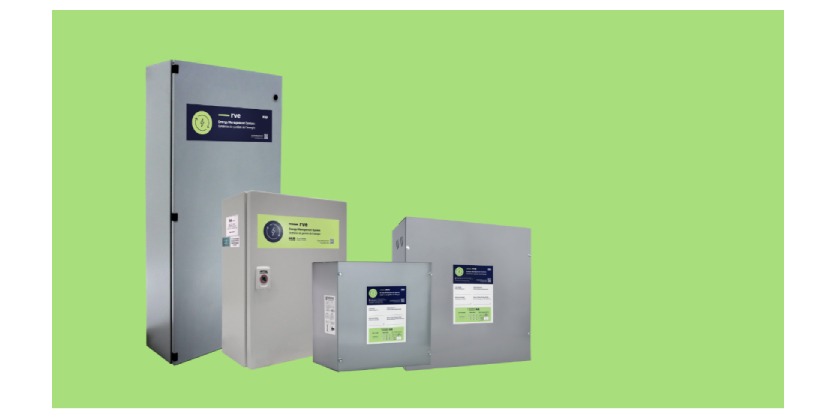
RVE solutions – the DCC and DCC+ charge controllers and the SMP+ smart panels – are based on local energy management, without relying on an external platform.
For DCC and DCC+ charge controllers:
- No monthly fees
- No subscription required
- No external platform required
The cost of the project is therefore entirely concentrated at the installation
For SMP+ smart panels:
- No recurring fees for basic features and energy management
- Free manual billing
- Fees apply if automated billing is enabled, whether through RVE Payment or a third-party platofmr
Over 2, 5, or 10 years, the total cost remains stable and predictable.
Another factor contributing to cost savings: the electrical distribution system
Beyond monthly costs, the connection method can also have a major impact on a building’s electrical infrastructure.
In some centralized systems, adding power may require an increase in the capacity of the electrical service entrance. This can result in significant and costly work.
For reference:
- A significant increase in electrical capacity can represent an investment of several hundred thousand dollars. This is typically the case when installing connected charging stations.
- An approach that utilizes the residual capacity of residential buildings, such as RVE’s, does not require any increase in electrical capacity.
The model chosen therefore affects not only monthly charges but also the infrastructure costs associated with electricity distribution.
In summary
In multifamily buildings, it is important to consider not only the upfront installation costs (CAPEX) but also the recurring expenses associated with the chosen solution (OPEX).
Some solutions may seem more cost-effective at the outset.
But when you factor in recurring costs and the impact on the electrical infrastructure, the difference becomes significant over time.
Monthly costs can turn an affordable project into a heavy financial burden over 10 years.
Please note: The amounts presented are based on real data and comparative analysis and are provided for illustrative purposes. They may vary depending on the context and specific parameters of each project.
More Information
Learn more about the economic potential of the RVE Solution