
Boosting In-Vehicle Reliability with Robust Low Voltage Power Distribution
July 6, 2026
Written by Marc Moser, VP Market Manager Automotive
Low voltage power distribution is central to meeting the growing demands of today’s vehicles, especially since safety, efficiency and increasing electrical complexities all rely on a stable electrical backbone to work effectively.
Modern vehicles now contain approximately 3-4 km of wiring to facilitate this distribution, with manufacturers implementing new comfort features such as infotainment and connected services. For electric vehicles (EVs), this figure stretches to 5 km and beyond due to added sensors, data lines, and power electronics.
This growth is reflective of the broader shift in how electrical systems are structured, with power delivery and communication now operating as a unified system. As a result, low voltage distribution must evolve alongside these developments.
How is in-vehicle power distribution evolving?
In-vehicle power distribution is evolving to support increasingly sophisticated low voltage functions. This is intensifying low voltage wiring demands as these systems must operate reliably under tighter packaging constraints, higher thermal loads, and greater complexities while maintaining long-term reliability.
These functions are interdependent within architectures. Low voltage power enables the continuous communication between power distribution and sensing networks such as data links and signalling pathways. This means that above all, the cables and wiring solutions that carry this voltage between components must operate efficiently and reliably.
How do low voltage cabling solutions address different in-vehicle requirements?
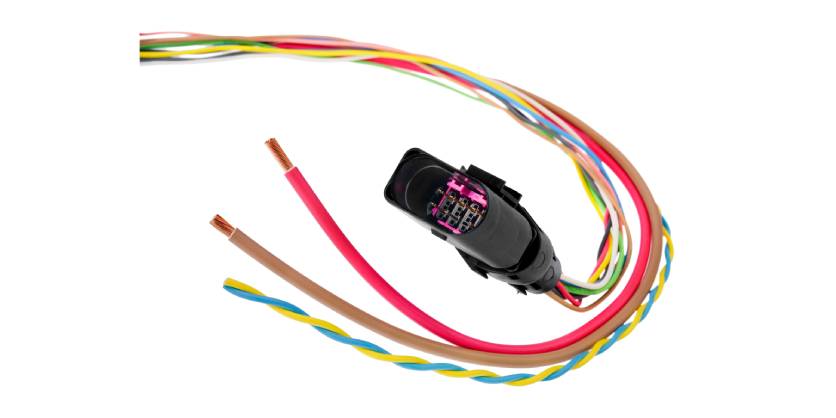
At HUBER+SUHNER, their long-standing expertise within the automotive sector enables them to deliver a comprehensive portfolio capable of providing this reliability. Their low voltage solutions offering, consisting of RADOX® Single Core, Multi Core, and Anticapillary cables, is providing manufacturers with the tools to utilise optimal battery power and electrical transmission.
Single-core cables are typically used where individual power or signal lines are required, offering flexibility and straightforward routing for discrete functions. Multi-core solutions differ by combining multiple conductors, enabling more compact, efficient wiring. Both cables are used in automotive systems to distribute up to 48V DC power and to carry signalling, data, and sensor signals across the vehicle.
Even then, some vehicle architectures don’t fit the bill for standard off-the-shelf integration. This is why HUBER+SUHNER offer customised solutions, meaning any cable can be tailored to the vehicle’s exact needs, ready for instant integration. That way, wiring is made efficient as possible in even the most complex of environments.
What are the benefits of HUBER+SUHNER low voltage solutions?
Using the RADOX® DNA, each solution is engineered for high electrical performance even under elevated temperatures, while offering robust resistance to mechanical stress, fluids, vibration and other disruptive influences. This ensures long-term functional integrity despite the harsh environmental conditions these vehicles face daily, supporting reliable operations across safety and performance critical systems.
In tandem, the unparalleled transmission of the cables that links components reassure manufacturers that electrical power, signalling, and data can be maintained with consistent integrity across increasingly complex vehicle architectures.
This compact design supports continuous operation from -40°C to 200 °C, ensuring reliability even under extreme thermal stress, bringing a complete wiring solution that never sacrifices performance or durability. RADOX® cables can be integrated to perform just like conventional wiring too, from termination and reel packaging to storage, recycling and end-of-life processing.
Connecting today and beyond
Together, these capabilities position HUBER+SUHNER as a long-term partner for those navigating the rapid evolution of in-vehicle networks. Supporting applications ranging from power distribution, through to signalling transmission, data communication and sensor connectivity, these solutions ensure dependable performance across increasingly integrated vehicle systems.
Through the combination of advanced materials, electron-beam crosslinking RADOX® technology and HUBER + SUHNER’s decades of automotive expertise, they are enabling manufacturers to build electrical systems that are lighter, resilient and future-proofed for the next generation of mobility.