
Along the Entire Value Chain: Quality Control in Battery Manufacturing

June 17, 2025
Inline quality control in battery production is a highly sought-after but also very demanding task in this complex process. This applies to various levels of battery manufacturing: electrode, cells, modules and packs. A common concern throughout: the overall equipment effectiveness (OEE). Having the right combination of suitable hardware – sensors, cameras or inspection systems – as well as AI-assisted software for evaluating the quality-relevant data generated in the process plays an important role in this.
Manufacturing batteries for electric vehicles and stationary energy storage systems (ESS) is an extremely complex process. Many of the sub-processes are themselves complex. It is therefore not a given that the user or plant will achieve a low reject rate.
Quality improvement as key factor
For this reason, it is normal to find numerous quality inspection stations in the gigafactories for battery manufacturing. The aim here is to separate out faulty components immediately, preferably before the subsequent processing step.
That saves costs and gives the plant operator the possibility of detecting irregularities in the process early and intervening as quickly as possible. At the same time, it is necessary to ensure a consistently high output because despite its complexity, battery manufacturing is a very cost-sensitive process. The customers in the automotive industry expect a continuously falling target price per kWh and the competition among the international battery manufacturers is extremely fierce. Consequently, numerous quality-relevant parameters need to be continuously monitored and kept stable both during production start-up and when operating the plant at full load. This applies to all three main levels of battery manufacturing: cells, modules and complete battery packs.
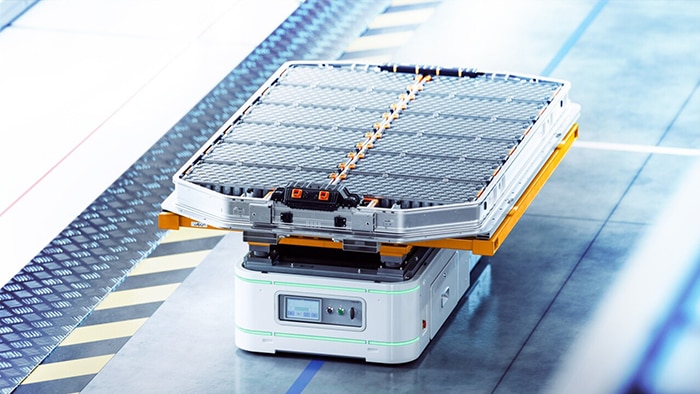
Central factor: the overall equipment effectiveness (OEE)
“Overall equipment effectiveness” (OEE) is a tried-and-proven KPI for the efficiency of a production plant or line. It is part of the “total productive maintenance” concept, the goal of which is a consistently efficient and interruption-free production.
To achieve this goal or to come as close as possible to it, you need to continuously monitor the processes – ideally as quickly and precisely as possible and in control loops so you can intervene quickly. This ensures a high performance, high quality, and minimal scrap rates and downtimes in (battery) production.
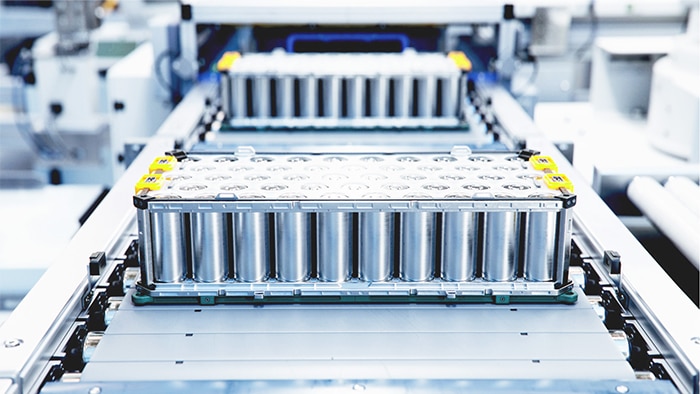
The full spectrum of inline quality control – all from a single source
The prerequisite for this is the use of state-of-the-art sensor technology for inline quality control. SICK offers both appropriate sensor and camera systems and other technologies as well as the necessary knowledge of battery manufacturing in order to select the best possible quality control system and integrate it into the process.
A large variety of technologies and applications are available to the user that can be purchased from a single source. The offerings range from comparatively simple 1D sensors to 2D image processing right through to sophisticated 3D inspections systems. All solutions scale very well with regard to their performance and, thanks to the comprehensive connectivity options, their signals can be evaluated in diverse ways or processed in the higher-level IT infrastructure (MES, PPS, ERP…).

Example sensor solutions in quality assurance for battery production
From electrode manufacturing to the quality inspection of cells right through to the thorough checking of modules and packs – the solutions from SICK cover the entire process chain in battery production. The following are a few example applications and suitable sensor solutions in each case:
- Tear and hole detection in electrode foils (MLG-02 light grid)
- Distance measurement on electrode arresters (InspectorP61x 2D vision sensor)
- Inspection of the cover of round cells (2D-BVA with Deep Learning/“Anomaly Detection”)
- Inspection of prismatic cells and insulation foils for scratches, dents, air inclusions (3D-BVA/Ruler or Ranger 39)
- Checking of weld spots (busbar) on modules and packs (D-BVA, Ruler)
- Foreign object detection during pack assembly (Ranger3, Foreign Object Detection System)
- Temperature measurement; “Hotspot Detection” to avoid fires (temperature sensors)