Littelfuse: RCMP20 Residual Current Monitor Series for Mode 2 and Mode 3 Charging Stations
November 4, 2024
Littelfuse, Inc. has recently announced the RCMP20 Residual Current Monitor Series for Mode 2 and Mode 3 EV charging stations.
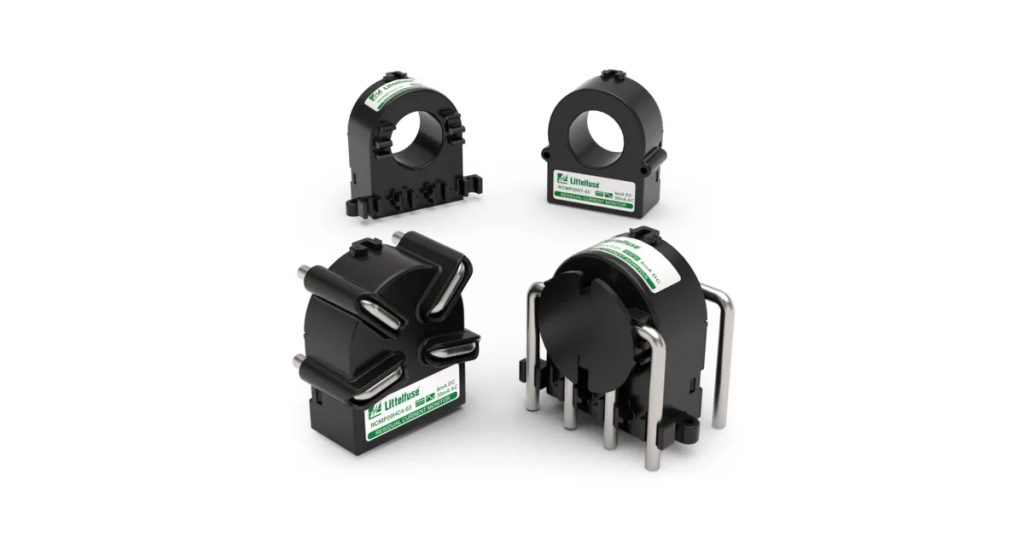
The RCMP20 Series sets a new standard in electric vehicle (EV) charging safety, offering superior performance and flexibility in a compact design while supporting higher charging currents than other solutions on the market. Featuring the largest current transformer (CT) aperture in the industry, this new line of products expands the Littelfuse EV infrastructure portfolio and enhances electrical safety in EV charging applications.
The RCMP20 Residual Current Monitor Series incorporates the following key features and benefits:
- Largest Current Transformer Aperture: The RCMP20 Series offers the largest current transformer (CT) aperture available, supporting higher AC charging currents, which is critical for modern EV chargers that demand high-performance capabilities.
- Enhanced Thermal Performance: Integrated conductors with higher cross-sectional areas provide better thermal management, reducing printed circuit board (PCB) temperature rise and allowing for a more compact design without compromising performance.
- High EMI Resilience: The modules are designed to resist electromagnetic interference (EMI), minimizing false circuit trips and improving overall charging station reliability.
- Flexible Mounting Options: With vertical and horizontal mounting options and 2 to 4 integrated conductors, the RCMP20 Series allows design engineers to optimize space utilization and adapt to various charger configurations.
- Compact Design with PCB Integration: The reduced footprint within the EV chargers allows for smaller, more compact designs, while still meeting safety code requirements. The integrated PCB with optional conductors streamlines installation, reduces component count, and simplifies assembly.
The RCMP20 Series is ideal for the following applications:
- EV Infrastructure: As electric vehicle adoption grows, robust EV infrastructure is critical. The RCMP20 Series ensures safe, efficient, and reliable charging station operation.
- IEC Mode 2 and Mode 3 AC Charging Stations: The RCMP20 Series covers a wide range of charging needs, offering protection for both portable chargers and high-power permanent stations.
- Ground Fault Detection: It continuously monitors for AC and DC ground fault currents, ensuring compliance with electrical safety standards and preventing shock risks.
How it works
Mode 2 and Mode 3 EV charging stations differ mainly in how they handle fault currents, particularly AC and DC currents, and the level of protection they provide against electrical hazards.
- Mode 2 charging stations are typically used with earlier portable chargers and high-powered stations. These stations may not have built-in protection against both AC and DC fault currents, which can create safety risks. The RCMP20-03 module helps enhance safety by monitoring both AC and DC residual currents. When a ground fault, leakage, or residual current exceeds the threshold, the RCMP20-03 triggers a circuit shutdown, preventing electrical hazards. It is compliant with IEC 62752 standards for Mode 2 chargers.
- Mode 3 charging stations are used for more permanent and higher-powered charging setups. While they often have Type A RCDs (Residual Current Devices), these devices can miss dangerous DC currents, leaving users vulnerable. The RCMP20-01 module is specifically designed to detect DC residual currents that Type A RCDs overlook. When DC fault currents exceed the threshold, it signals a trip to a connected switching device, ensuring user protection and compliance with relevant safety standards.
In summary, Mode 2 systems with the RCMP20-03 monitor AC and DC faults to enhance protection for earlier or portable charging setups. In contrast, Mode 3 systems with the RCMP20-01 focus on detecting DC faults that standard RCDs miss, improving safety for permanent charging stations.
Availability
The RCMP20 Residual Current Monitors are available in individual boxes. Sample requests can be placed through authorized Littelfuse distributors worldwide.