
Teledyne FLIR OEM’s Compact Thermal-Visible Lepton® XDS and EV Charging Applications
March 16, 2026
By Krystie Johnston, with Chris Posch
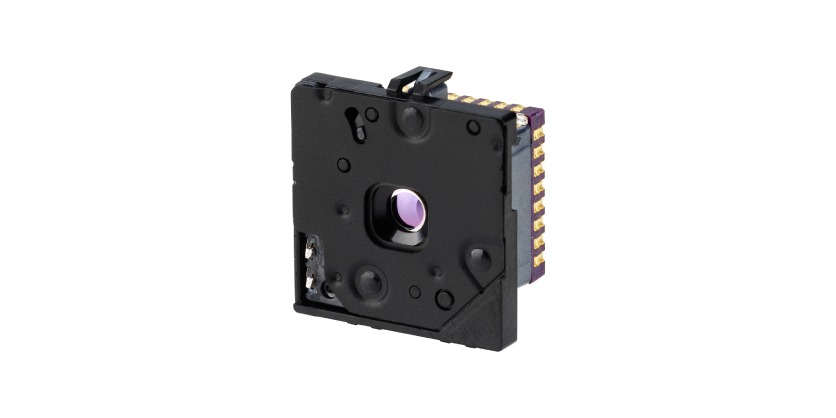
Teledyne FLIR OEM recently launched the Lepton® XDS at Mobile World Congress 2026. This compact, thermal-and- visual camera module incorporates Teledyne FLIR’s patented MXS® (Multi-Spectral Dynamic Imaging) technology, releasing new potential for OEM products. Chris Posch, Director of Emerging Product Management at Teledyne FLIR OEM, shares insights about how this new camera module is being used in EV charging applications.
Posch has spent more than 20 years in engineering and product development, working with automotive engineers and developers to deploy and test thermal sensors in ADAS (advanced driver assistance systems) and autonomous vehicle platforms. His experience also finds him working with OEMS (original equipment manufacturers) to integrate micro thermal cameras into professional and consumer products for emerging applications. In line with this, he focuses on delivering thermal imaging modules and software solutions that improve decision support and situational awareness across an array of sectors, including automotive, defense, and industrial.
In a class of its own
What sets the Lepton® XDS apart is that it integrates advanced features like Prism ISP software and VividIR. “For the first time, we are including our patented Multi-Spectral Dynamic Imaging (MSX) technology license with hardware,” Posch explains. “MSX enhances the thermal imagery by embossing visible image details directly onto the thermal image, providing sharper detail, improved context, and actional intelligence that is usually reserved for more expensive, higher-resolution cameras. And the Lepton also features VividIR, offering real-time image enhancement and industry-first radiometric JPEG output.”
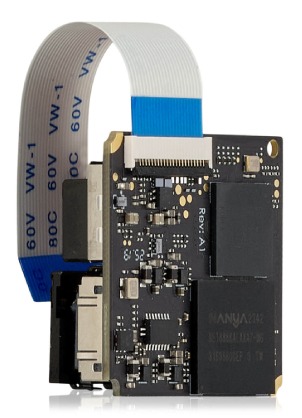
Posch adds that the XDS module was designed specifically for OEMs. It provides an easy way for them to integrate thermal and visible into their products. The fused system comes calibrated and aligned with a USB easy-to-use interface.
A powerful tool for EV charging infrastructure
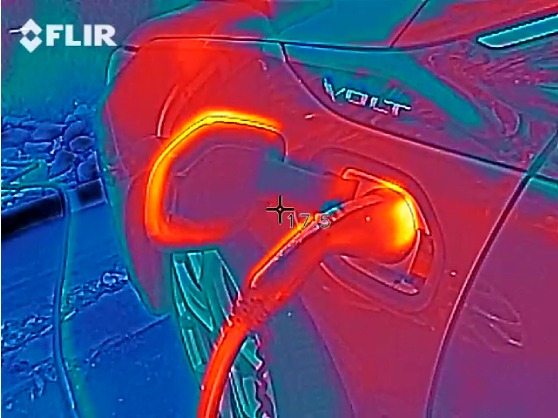
You might be wondering what, specifically, this innovative camera module – the Lepton® XDS – has to do with EV charging infrastructure. Posch explains that the Lepton® XDS serves as a powerful tool for early fire detection (EFD) and EV battery monitoring. “Traditional smoke or heat detecting sensors are limited in what they often only react after [emphasis added] a fire has already ignited. While still helpful, it is often too late to prevent significant damage to the charging infrastructure,” he says. “The Lepton® XDS on the other hand, is capable of identifying abnormal heat build-ups well before flames or smoke appear (like an overheating charging cable or battery cell entering thermal runaway).”
“The Lepton® XDS offers a proactive response to potential charging station hazards versus a reactive response which triggers after the damage is done,” Posch continues. “Furthermore, because the Lepton® XDS incorporates FLRI’s MSX technology and Prism ISP software [mentioned above], the ability for operators to identify what the thermal image is looking at is enhanced and easier than just a lone thermal image.”
Potential integration applications
Posch says that OEMs involved with EV charging infrastructure could integrate the Lepton® XDS directly into charging station hardware and connect it to a facility’s fire alarm control panel – either wirelessly or wired. He says USB allows for simple plug-and-play compatibility, enabling for fast time-to-market for charging infrastructure developers. Moreover, it can easily feed standardized alert events and video streams into existing systems.
“Non-contact charging stations such as your mobile phone’s wireless charging is also an emerging way to charge EV autonomous ground vehicles and is even being examined for EVs” Posch says. He adds that with these devices, it is imperative to ensure that objects like conductive metals from fallen screws, nuts, or nails, for example, are not on the charging pad.
“Thermal imaging can help identify objects on these charging pads even before electricity passes through them due to the difference in emissivity of the object. Using only a visible camera, it is difficult to achieve this due to the resolution or when the object is the same colour as the floor.”
Real-world example
Posch says that one of their Thermal by FLIR partners, Eye on Cloud (EOC), used a radiometric FLIR Lepton in 2023 for continuous monitoring of EV charging stations. “The Korean-based video security and thermal imaging IP company integrated Lepton into its HI166120OH and HI1612-MW series cameras for continuous monitoring of EV charging stations and other critical infrastructure, security, and facility applications to help identify elevated heat before ignition and trigger an alarm system, enabling fire personnel to attack a potential fire more quickly than when using traditional smoke alarms.”
How does the Lepton® XDS work?
For readers who are curious, Posch explains that the Lepton® XDS uses two sensors/cameras that complement each other:
- Thermal – measures infrared radiation to work in total darkness or through smoke to detect precise temperature spikes.
- Visible – adds visual context and combined with MSX can make the thermal image more interpretable for humans and AI.
The supporting software, Prism ISP, provides image signal processing. It offers real-time fusion, advanced image processing, and an industry-first radiometric JPEG output. These features allow users to set specific regions of interest, perform spot temperature measurements, and use customizable color palettes to highlight risk.
Next steps for Lepton® XDS
Posch says that technology like Teledyne FLIR OEM’s Lepton® XDS is moving toward becoming an industry standard. For example, the UL 2648 standard covers thermal imaging detectors in fire alarm systems. He adds that dual thermal/visible systems allow for the implementation of performance-based designs. “Meaning, a thermal alert can trigger a window for staff to verify the situation via the visible camera feed before a full shut down or evacuation is needed. This can significantly reduce the cost and disruption associated with false positives.”
Ultimately, the Lepton® XDS presents a shift from reactive to proactive fire prevention in EV charging systems. But that is not all in store for Teledyne FLIR OEM’s latest camera module. Posch says they fully expect the Lepton® XDS to be integrated into multiple mobile, smart city, and connected devices. “Our cameras, especially those in the Lepton family, have frequently been integrated by rugged mobile phone OEMs, as the cameras are size, weight, and power (SWaP) optimized and are ideal for battery-powered and always-on systems.”
More Information
Interested in learning more about Teledyne FLIR OEM’s Lepton® XDS? Visit their website today!
Related Story
Teledyne FLIR OEM Launches Lepton XDS at Mobile World Congress; A Compact Thermal‑Visible Camera Module Featuring Patented MSX Technology
Teledyne FLIR OEM, a part of Teledyne Technologies Incorporated (NYSE: TDY), announced on February 24, 2026, the launch of the Lepton® XDS, a compact dual‑thermal‑and‑visible camera module bringing Teledyne FLIR’s patented MSX® (Multi‑Spectral Dynamic Imaging) technology to a new class of space‑ and power‑constrained Original Equipment Manufacturer (OEM) products. Designed for rapid integration, the International Traffic in Arms Regulations (ITAR) -free Lepton XDS reduces development risk and accelerates time‑to‑market for embedded, mobile, and industrial applications.