
EV Charging Station Market Size, Share & Analysis
September 15, 2026

EV Charging Station Market by DC Fast Charging, Application, Level of Charging, Charging Point (AC & DC), Charging Infrastructure, Operation, Charge Point Operator, Connection Phase, Service, Installation, and Region – Global Forecast to 2033.
Overview
Source: Secondary Research, Interviews with Experts, MarketsandMarkets Analysis
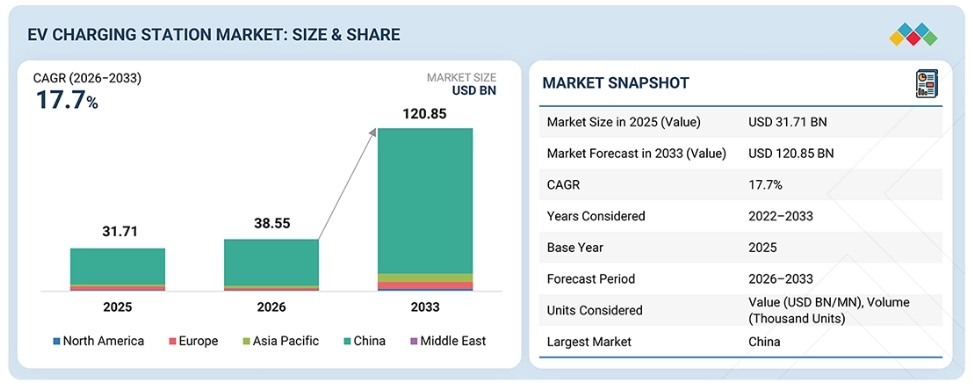
The global EV charging station market is projected to grow from USD 38.55 billion in 2026 to USD 120.85 billion by 2033 at a CAGR of 17.7%. The market is transitioning from an infrastructure buildout phase to a network scaling phase characterized by aggressive charging point deployment, expansion of high-power charging corridors, and increasing charger density across key EV markets. Rising EV parc growth, national electrification targets, and investments from charge point operators, utilities, oil & gas companies, and automotive OEMs are accelerating the installation of residential, workplace, public, fleet, and highway charging stations worldwide. The market is witnessing strong momentum toward ultra-fast DC charging networks and Megawatt Charging Systems (MCS) to support long-distance travel and commercial vehicle electrification. Competitive positioning is increasingly linked to charging network coverage, charger utilization, strategic site acquisition, and corridor accessibility. As governments and private stakeholders continue expanding charging infrastructure footprints, the market is expected to play a central role in reducing range anxiety, supporting EV adoption, and enabling large-scale electrification of passenger and commercial transportation.
EV Charging Station Market Size and Forecast:
- Market Size Value in 2025: USD 31.71 Billion
- Market Size Value in 2026: USD 38.55 Billion
- Revenue Forecast in 2033: USD 120.85 Billion
- Growth Rate: CAGR of 17.7% from 2026 to 2033
- Data available from 2022 to 2033
- Base year: 2025
- Forecast period: 2026–2033
- Largest Growing Region: Asia Pacific
- Units Considered: Value (USD Billion), Volume (Units)
Key Market Trends and Insights
- Market Growth: The EV charging station market growth is driven by increasing electric vehicle adoption, government incentives, expansion of public charging infrastructure, and investments in fast-charging networks.
- Smart Charging Impact: Smart charging technologies, IoT connectivity, and AI-enabled energy management improve charger efficiency, optimize power distribution, and support grid stability.
- Growing Trends: The EV charging station market key trends include rapid deployment of DC fast chargers, ultra-fast charging stations, vehicle-to-grid (V2G) integration, and renewable energy-powered charging infrastructure.
- Growth Opportunities: The EV charging station market opportunities include expanding charging infrastructure for commercial EV fleets, highway fast-charging corridors, wireless charging solutions, and AI-driven charging network management.
Key Takeaways
- China is expected to lead the market during the forecast period.
- Fixed charging is estimated to dominate the EV charging station market in 2026.
- Level 3 is expected to register the highest CAGR during the forecast period.
- Mode 4 is projected to experience the highest growth rate during the forecast period.
- Major players in the EV charging station market are adopting both organic and inorganic growth strategies, including partnerships, investments, capacity expansion, and technology development initiatives. For instance, ABB (Switzerland), BYD Company Ltd. (China), and ChargePoint (US) have entered into multiple agreements and strategic collaborations to strengthen charging infrastructure capabilities, secure component supply, and meet the growing demand for EV charging across global markets.
- Electrify America (US) and Vattenfall AB (Sweden), among others, have distinguished themselves among startups and SMEs by securing strong footholds in specialized niche areas, underscoring their potential as emerging market leaders.
The EV charging station market is set for sustained high growth, driven by accelerating EV adoption, expanding public and private infrastructure investments, and the increasing strategic role of charging networks in OEM electrification strategies. DC fast charging and megawatt charging are emerging as the fastest-growing segments, supported by rising demand from commercial fleets, logistics operators, and long-distance mobility applications. The competitive landscape is shifting from charger deployment toward ecosystem control, with companies including Tesla, ChargePoint, IONITY, and BP Pulse expanding into software platforms, fleet charging services, energy management, and charging subscriptions to strengthen recurring revenue opportunities. Network interoperability, grid capacity constraints, and charger utilization efficiency will remain key factors influencing investment priorities and competitive positioning throughout the forecast period.
Trends & Disruptions Impacting Customers’ Customers
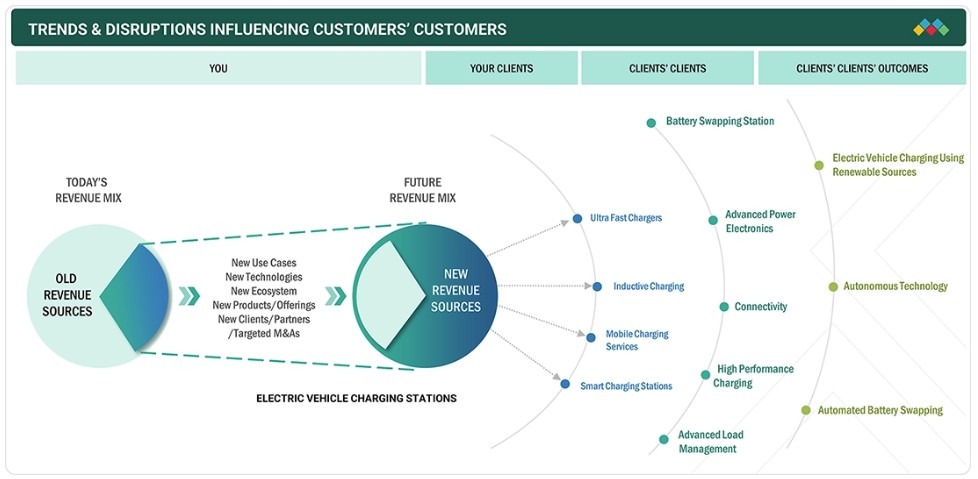
The EV charging station market is transitioning from a manufacturing-focused industry toward a technology- and service-driven ecosystem. Current revenues are mainly generated from battery cells, pack assembly, and material supply, while future growth is expected from advanced chemistries, battery software, recycling, and energy storage applications. The shift is creating stronger collaboration between battery manufacturers, OEMs, infrastructure providers, and energy companies. This evolution ultimately supports longer driving range, faster charging, improved battery lifecycle management, and lower operating costs for end users.
Market Dynamics
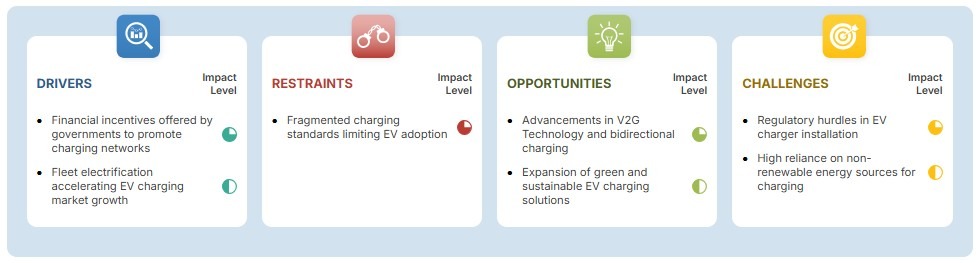
Driver: Financial incentives offered by governments to promote charging networks
Government subsidies, tax credits, and grants are lowering the upfront cost of charging infrastructure for operators, businesses, and individual EV owners. As these incentives are increasingly tied to national net-zero commitments, they remain one of the strongest near-term catalysts for charging network expansion worldwide.
Restraint: Fragmented charging standards limiting EV adoption
The coexistence of multiple connector standards — CCS, CHAdeMO, GB/T, and NACS — across regions creates interoperability challenges for manufacturers and inconvenience for EV drivers travelling between markets. This lack of a unified global standard continues to slow the pace and efficiency of charging infrastructure rollout.
Opportunity: Expansion of green and sustainable EV charging solutions
Charging stations integrating solar power, battery storage, and microgrid capabilities are reducing grid dependence and operating costs, particularly in regions with limited grid access. As sustainability becomes a growing priority for governments and businesses, such solutions offer a clear competitive advantage and new revenue potential.
Challenge: Regulatory hurdles in EV charger installation
Inconsistent permitting processes, safety codes, and grid connection approvals across regions extend installation timelines and raise project costs. This regulatory complexity continues to slow the pace of new charging infrastructure deployment globally.
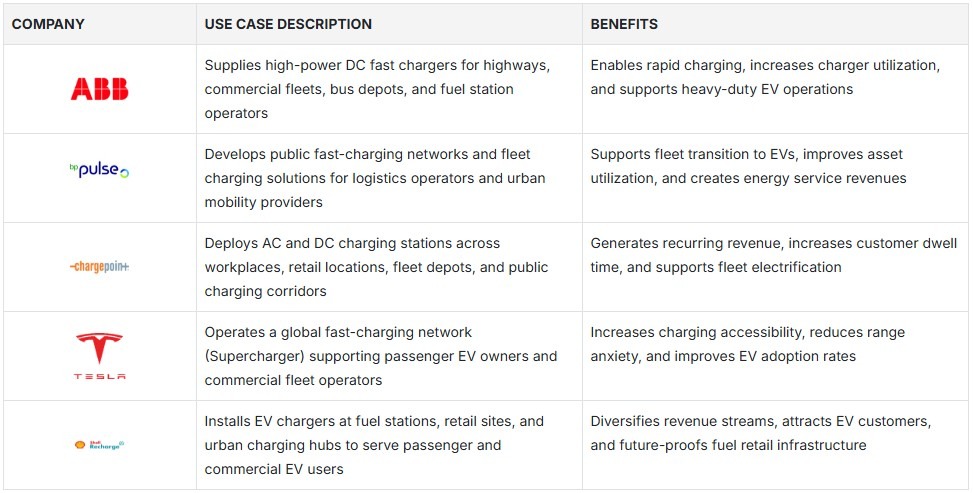
EV Charging Station Market Size, Share & Analysis: Commercial Use Cases Across Industries
Market Ecosystem
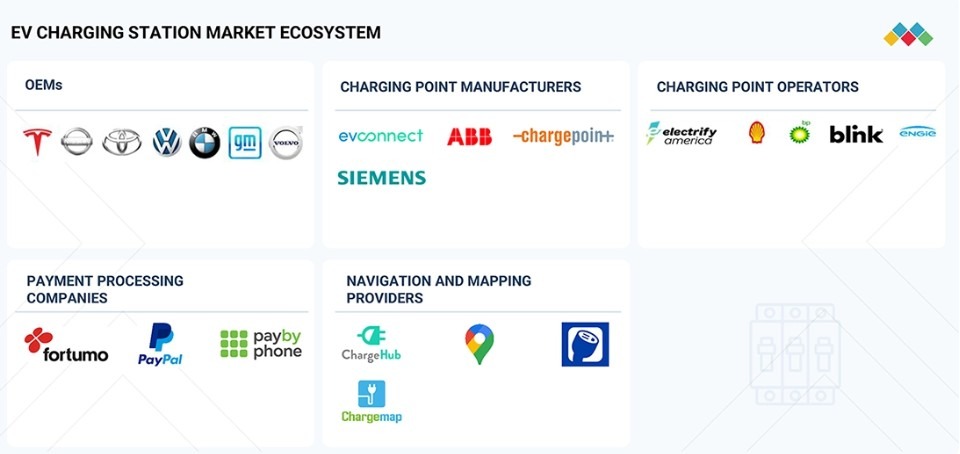
The ecosystem mapping highlights various players in the EV charging station market ecosystem, primarily represented by OEMs, EV charging station providers, service providers, and component manufacturers. OEMs are EV manufacturers that primarily drive the demand for EV charging stations. In collaboration with other stakeholders, EV charging point manufacturers undertake R&D activities related to EV charging technology to develop products that can be integrated into the architecture of different charging system capabilities. CPOs act as intermediaries between charging station owners and EV drivers, providing services that help ensure that the charging network is reliable and convenient for drivers. Payment processing companies enable secure and efficient transactions between charging station owners and EV drivers. Navigation and mapping providers offer a range of services that help EV drivers locate and navigate to the nearest charging station and provide information about the station’s availability, type of charger, and pricing.
Market Segments
EV Charging Station Market, By Application
The private application segment is expected to be the largest, supported by the growing integration of EV charging infrastructure into residential communities, corporate campuses, and commercial properties, where users benefit from dedicated charging access and lower operating costs.
EV Charging Station Market, By Charging Infrastructure Type
Type 1 (J1772) is estimated to account for the largest share of the global EV charging station market by charging infrastructure type in 2026, owing to its deeply established installed base across North America and Japan, where it remains the dominant AC charging standard for existing vehicle fleets and charging infrastructure.
EV Charging Station Market, By Charging Point Type
AC charging is estimated to account for the largest share of the EV charging market in 2026 due to its widespread deployment across residential, workplace, destination, and semi-public charging environments, making it the most broadly accessible charging technology globally.
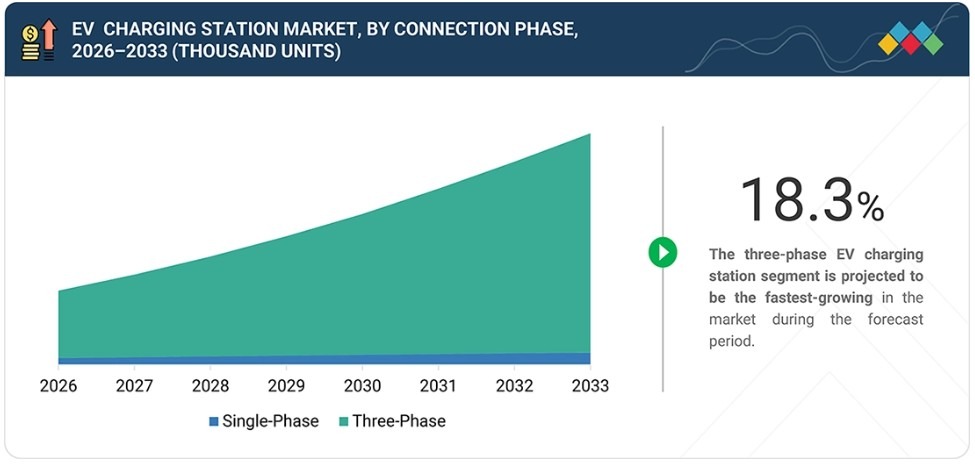
EV Charging Station Market, By Connection Phase
Single-phase is estimated to account for the dominant share of the EV charging station market by connection phase in 2026, driven by its compatibility with existing low-voltage distribution networks and its ability to support large-scale charging deployment without extensive grid upgrades.
EV Charging Station Market, By DC Fast Charging Type
Slow DC (below 50 kW) is estimated to account for the largest share of the DC charging station market by charging speed in 2026, owing to its cost-effectiveness and suitability for fleet depots, workplaces, and residential complexes where vehicles remain parked for extended durations.
EV Charging Station Market, By Installation Type
Fixed charging stations are estimated to account for the largest share of the EV charging station market by installation type in 2026, driven by their permanent integration into public charging networks, commercial facilities, fleet depots, and transportation corridors, where reliability and continuous availability are critical.
EV Charging Station Market, By Level of Charging
Level 1 is estimated to account for the largest share of the EV charging station market by charging level in 2026 due to its universal compatibility with standard household outlets and its position as the most accessible entry-level charging solution for EV owners globally.
EV Charging Station Market, By Mode
Mode 1 is estimated to account for the largest share of the EV charging station market by charging mode in 2026, supported by its widespread inclusion as a standard charging solution with electric vehicles and its continued adoption in markets where dedicated charging infrastructure remains limited.
Region
China to lead global EV charging station market during forecast period
China is projected to account for the largest share of the global EV charging station market. The country’s leadership is driven by the close alignment between EV production growth, charging infrastructure deployment, and national electrification targets. China remains the world’s largest EV market, with OEMs such as BYD, SAIC, Geely, NIO, Xpeng, and Li Auto continuing to expand vehicle sales and charging ecosystem investments simultaneously. The market benefits from strong participation across the value chain, including utilities, charging network operators, and local governments, enabling rapid infrastructure scaling. China also leads global deployment of public fast charging infrastructure, supporting both passenger vehicle and commercial fleet electrification. This integrated approach, combining vehicle adoption, infrastructure expansion, and ecosystem investment, is expected to reinforce China’s dominant position in the global market during the forecast period.
EV Charging Station Market Size, Share & Analysis: Company Evaluation Matrix
In the EV charging station market matrix, ABB (Star) leads with a strong combination of global charging infrastructure scale, broad OEM and fleet partnerships, and advanced power electronics capabilities, driving market expansion and revenue growth through continuous capacity additions, cost competitiveness, and commercialization of next-generation high-power charging platforms. Delta Electronics (Emerging Leader) is gaining traction with the expansion of its regional production footprint, strategic supply agreements with charging network operators, and investments in fast and smart charging technologies. The company shows strong growth potential to advance toward the leaders’ quadrant through increasing manufacturing scale and strengthening its position in North America and Europe.
Key Market Players
- ABB (Switzerland)
- BYD Company Ltd. (China)
- ChargePoint Inc. (US)
- Tesla (US)
- EVBox (Netherlands)
- Delta Electronics Inc. (Taiwan)
- Siemens (Germany)
- Schneider Electric (France)
- Kempower OYJ (Finland)
- EFACEC (Portugal)
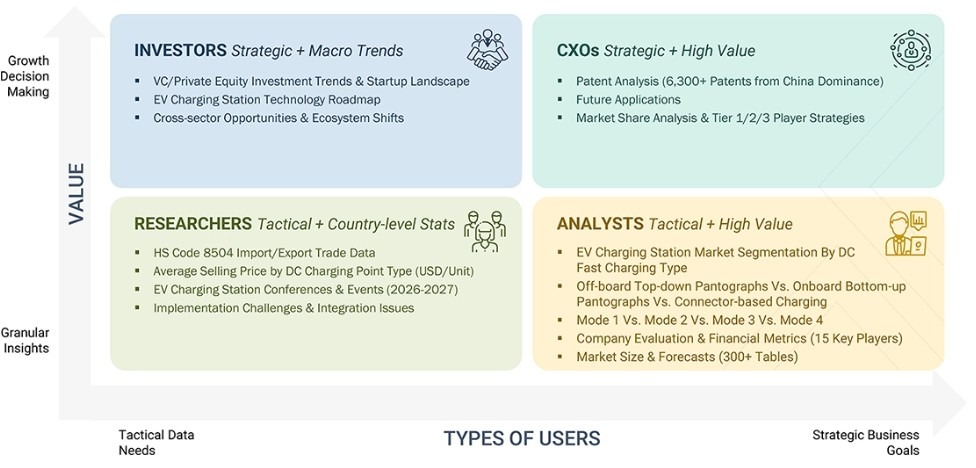
What Is in It for You: EV Charging Station Market Size, Share & Analysis Report Content Guide
Delivered Customizations
Markets and Markets hassuccessfully delivered the following deep-dive customizations:
| CLIENT REQUEST | CUSTOMIZATION DELIVERED | VALUE ADDED |
| Global Passenger Vehicle OEM | Competitive benchmarking of ABB, ChargePoint, Tesla, Siemens, and Delta Electronics | Charging partner selection strategy assessment by region |
| Charging Equipment Manufacturer (China) | Market sizing by charger type (AC, DC, ultrafast) and application segment | Capacity expansion and technology roadmap analysis |
| Commercial Fleet Operator (North America) | Evaluation of charging infrastructure requirements across vans, trucks, and buses | Analysis of charger type adoption (AC, DC fast, ultrafast) |
| Charge Point Operator (Asia Pacific) | Assessment of charger utilization rates and network profitability economics | Competitive benchmarking of CPO business models and regional policies |
| Investment Firm (Global) | Identification of emerging charging infrastructure startups and deployment pipeline | Financial benchmarking and market attractiveness analysis |
Recent Developments
May 2026: ChargePoint and OBE Power announced a partnership to deploy approximately 2,500 EV charging ports at multifamily housing properties, with ChargePoint’s chargers, software, and services serving as the exclusive technology platform for the multifamily charging segment.
April 2026: CATL announced a partnership with SAIC-GM-Wuling Auto to develop fast-charging technology and battery-swap-compatible vehicles capable of charging from 10% to 80% in 10 minutes or less.
April 2026: XCharge North America partnered with JOJO Superfast EV Charging to deploy a network of 150 kW and 350 kW DC fast charging stations across underserved rural and suburban markets in the US Midwest, with a target of 200 stations by end-2027.
March 2026: Trinity Cleantech acquired German startup ME Energy, which specializes in off-grid fast-charging stations, following the latter’s insolvency filing.
January 2026: Autel Energy launched its latest AC and DC charging solutions, including its Avant product family, at CES 2026 in Las Vegas.
Related Story
Electric Vehicle Market to Grow from USD 1,145.51 Billion in 2025 to USD 1,857.34 Billion by 2035, at a CAGR of 5.0% — MarketsandMarkets™
MarketsandMarkets™ projects the global Electric Vehicle market is projected to grow from USD 1,145.51 billion in 2025 to USD 1,857.34 billion in 2035 at a CAGR of 5.0%. The electric vehicle market is on a steady growth path, supported by rising consumer demand, government mandates for lower emissions, and advancements in battery and charging technologies that enable higher driving ranges, lower battery costs, and faster charging times.