
Researchers Announce Breakthrough for ‘Massless’ Energy Storage for EVs

January 22, 2025
Researchers from Chalmers University of Technology have produced a structural battery that performs ten times better than all previous versions. It contains carbon fibre that serves simultaneously as an electrode, conductor, and load-bearing material. Their latest research breakthrough paves the way for essentially ’massless’ energy storage in vehicles and other technology.
The batteries in today’s electric cars constitute a large part of the vehicles’ weight, without fulfilling any load-bearing function. A structural battery, on the other hand, is one that works as both a power source and as part of the structure – for example, in a car body. This is termed ‘massless’ energy storage, because in essence the battery’s weight vanishes when it becomes part of the load-bearing structure. Calculations show that this type of multifunctional battery could greatly reduce the weight of an electric vehicle.
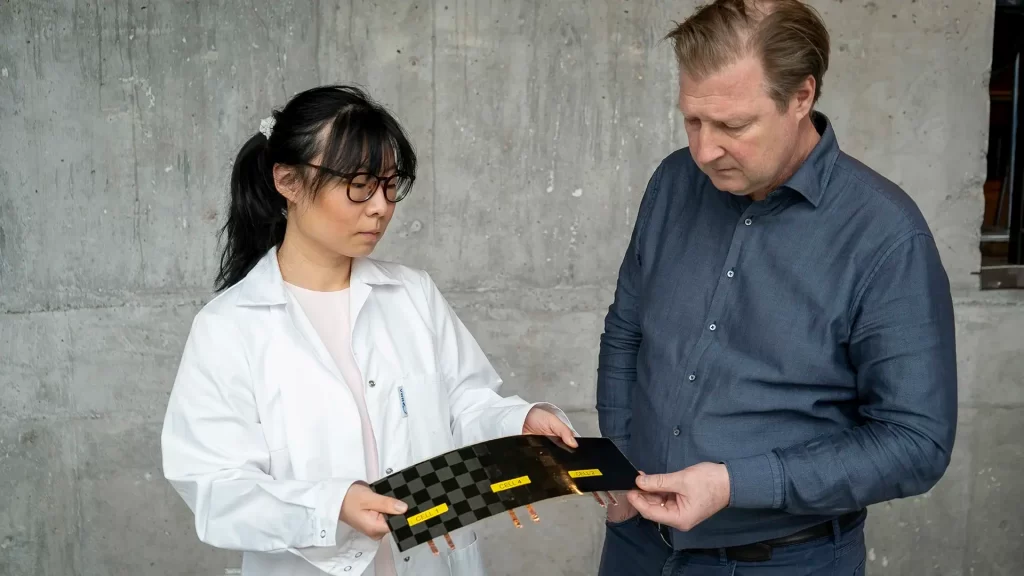
Johanna Xu Assistant Professor, Material and Computational Mechanics, Industrial and Materials Science and Leif Asp Full Professor, Material and Computational Mechanics, Industrial and Materials Science with a newly manufactured structural battery cell in Chalmers’ composite lab.
The development of structural batteries at Chalmers University of Technology has proceeded through many years of research, including previous discoveries involving certain types of carbon fibre. In addition to being stiff and strong, they also have a good ability to store electrical energy chemically. This work was named by Physics World as one of 2018’s ten biggest scientific breakthroughs.
The first attempt to make a structural battery was made as early as 2007, but it has so far proven difficult to manufacture batteries with both good electrical and mechanical properties.
But now the development has taken a real step forward, with researchers from Chalmers, in collaboration with KTH Royal Institute of Technology in Stockholm, presenting a structural battery with properties that far exceed anything yet seen, in terms of electrical energy storage, stiffness and strength. Its multifunctional performance is ten times higher than previous structural battery prototypes.
The battery has an energy density of 24 Wh/kg, meaning approximately 20 percent capacity compared to comparable lithium-ion batteries currently available. But since the weight of the vehicles can be greatly reduced, less energy will be required to drive an electric car, for example, and lower energy density also results in increased safety. And with a stiffness of 25 GPa, the structural battery can really compete with many other commonly used construction materials.
“Previous attempts to make structural batteries have resulted in cells with either good mechanical properties, or good electrical properties. But here, using carbon fibre, we have succeeded in designing a structural battery with both competitive energy storage capacity and rigidity,” explains Leif Asp, Professor at Chalmers and leader of the project.
Super light electric bikes and consumer electronics could soon be a reality
The new battery has a negative electrode made of carbon fibre, and a positive electrode made of a lithium iron phosphate-coated aluminium foil. They are separated by a fibreglass fabric, in an electrolyte matrix. Despite their success in creating a structural battery ten times better than all previous ones, the researchers did not choose the materials to try and break records – rather, they wanted to investigate and understand the effects of material architecture and separator thickness.
Now, a new project, financed by the Swedish National Space Agency, is underway, where the performance of the structural battery will be increased yet further. The aluminium foil will be replaced with carbon fibre as a load-bearing material in the positive electrode, providing both increased stiffness and energy density. The fibreglass separator will be replaced with an ultra-thin variant, which will give a much greater effect – as well as faster charging cycles. The new project is expected to be completed within two years.
Leif Asp, who is leading this project too, estimates that such a battery could reach an energy density of 75 Wh/kg and a stiffness of 75 GPa. This would make the battery about as strong as aluminium, but with a comparatively much lower weight.
“The next generation structural battery has fantastic potential. If you look at consumer technology, it could be quite possible within a few years to manufacture smartphones, laptops or electric bicycles that weigh half as much as today and are much more compact”, says Leif Asp.
And in the longer term, it is absolutely conceivable that electric cars, electric planes and satellites will be designed with and powered by structural batteries.
“We are really only limited by our imaginations here. We have received a lot of attention from many different types of companies in connection with the publication of our scientific articles in the field. There is understandably a great amount of interest in these lightweight, multifunctional materials,” says Leif Asp.
Read the article in the scientific journal Advanced Energy & Sustainability Research: A Structural Battery and its Multifunctional Performance